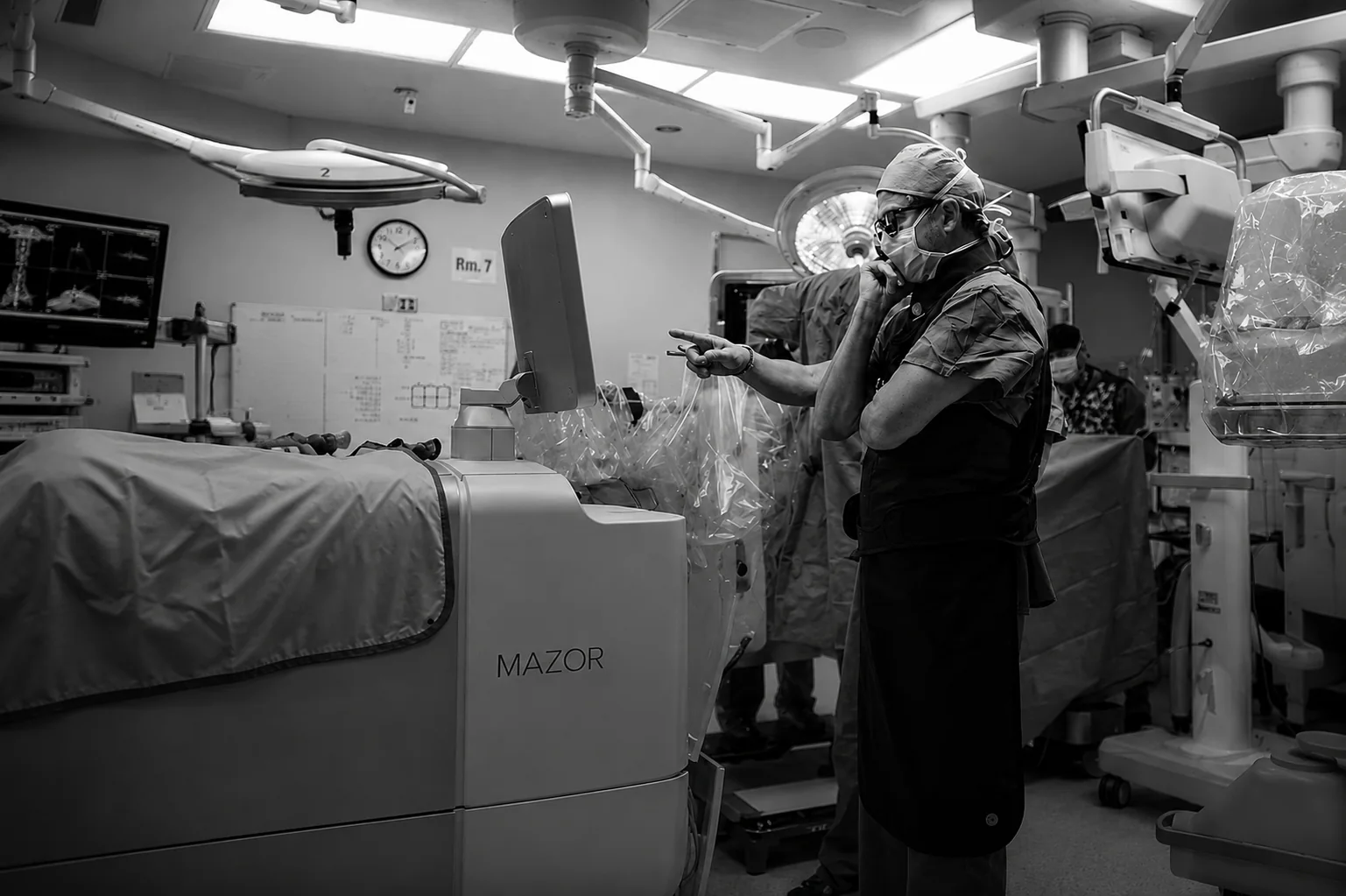
Dr. Rod J. Oskouian in the operating room with the Mazor robotic spine surgery system
Robotic Spine Surgery

Robotic spine surgery.
Not a trend.
A tool.

Oskouian uses Medtronic AiBLE navigation and Stryker robotic platforms at Swedish Neuroscience Institute. He adopted these systems before they were routine because the accuracy data supported them, and he continues to use them for the same reason.

Nearly 20 years ago, we performed a lateral lumbar corpectomy first in the lab, then on a patient. Everyone said it couldn't be done. We proved them wrong. Now it's standard of care across the globe.

Dr. Rod J. Oskouian, MD, FAANS
Philosophy

Why robotics
in the OR.

For patients who need it, robotic guidance is the difference between a screw placed within a fraction of a millimeter of its target and one that is not.

  • Uses Medtronic AiBLE and Stryker platforms as a clinician, not a salesperson
  • Chose these tools because the data and outcomes support them
  • The next decade belongs to surgeons who understand both anatomy and the algorithms that assist them
0+
Years in Complex Spine Surgery
0+
Surgical Cases
Day 1
Early adopter of robotic navigation, not a late follower
AANS
NASS · AOSpine · Faculty
Clinical Capabilities

What robotic
guidance enables.

Not every case requires robotic assistance. The ones that do, require it absolutely.

01/04
Sub-millimeter accuracy
Open each capability to read why it matters
01
Sub-millimeter accuracy on pedicle screw placement
At the spinal cord, the nerve root, the vertebral artery: sub-millimeter accuracy matters in a way that cannot be approximated by hand.
02
Reduced radiation exposure
For patient and surgeon alike. Fewer fluoroscopic passes across years of practice is a career-altering benefit.
03
Minimally invasive access to previously inaccessible anatomy
Navigation-assisted robotics extends reach through a smaller corridor, reducing tissue disruption and recovery time in procedures that once required open exposure.
04
Reproducible, trainable technique
A robotic workflow that can be taught, refined, and handed to the next generation is both a clinical tool and an educational infrastructure. That is why Dr. Oskouian uses it.
Innovation Milestones

Two decades of
firsts.

Every technique that is now routine was once a question someone had to be willing to answer in the operating room.

Early 2000s

Lateral approaches pioneered

First lateral lumbar corpectomies performed in the lab, then the OR, before these approaches had formal names or widespread US adoption.
Post-Fellowship

Fellowship program development

Built structured training pathways for spine fellows; technique rigor embedded from case one.

2008 onward

Seattle Science Foundation

Co-founded SSF and served as its President and CEO; now Chief Executive Officer. Created infrastructure for collaborative surgical research, anatomy education, and robotic spine surgery.

2014

Global surgical collaboration

Collaborating with surgeons from Kenyatta National Hospital since 2014, building local neurosurgical capacity in East Africa.

Present

Robotic and AI-guided surgery

Active clinical use of Medtronic AiBLE and Stryker platforms; contributing bibliometric analysis of AI in spine surgery to separate signal from noise.

Technology Partners
Platforms used clinically
Medtronic · Mazor / AiBLE Stryker vbspine
Financial relationships disclosed per CMS Open Payments database.
Where This Program Is Headed

What comes next
in robotic spine surgery
at Swedish.

  • AI-assisted preoperative planning research
  • Bibliometric analysis of published robotic spine outcomes to identify solid evidence versus accumulating signal
  • Integration of robotic guidance with intraoperative navigation

Fellows at Swedish learn robotic technique alongside conventional approaches. Knowing when to use a tool matters as much as knowing how.

Speaking engagements Contact Dr. Oskouian